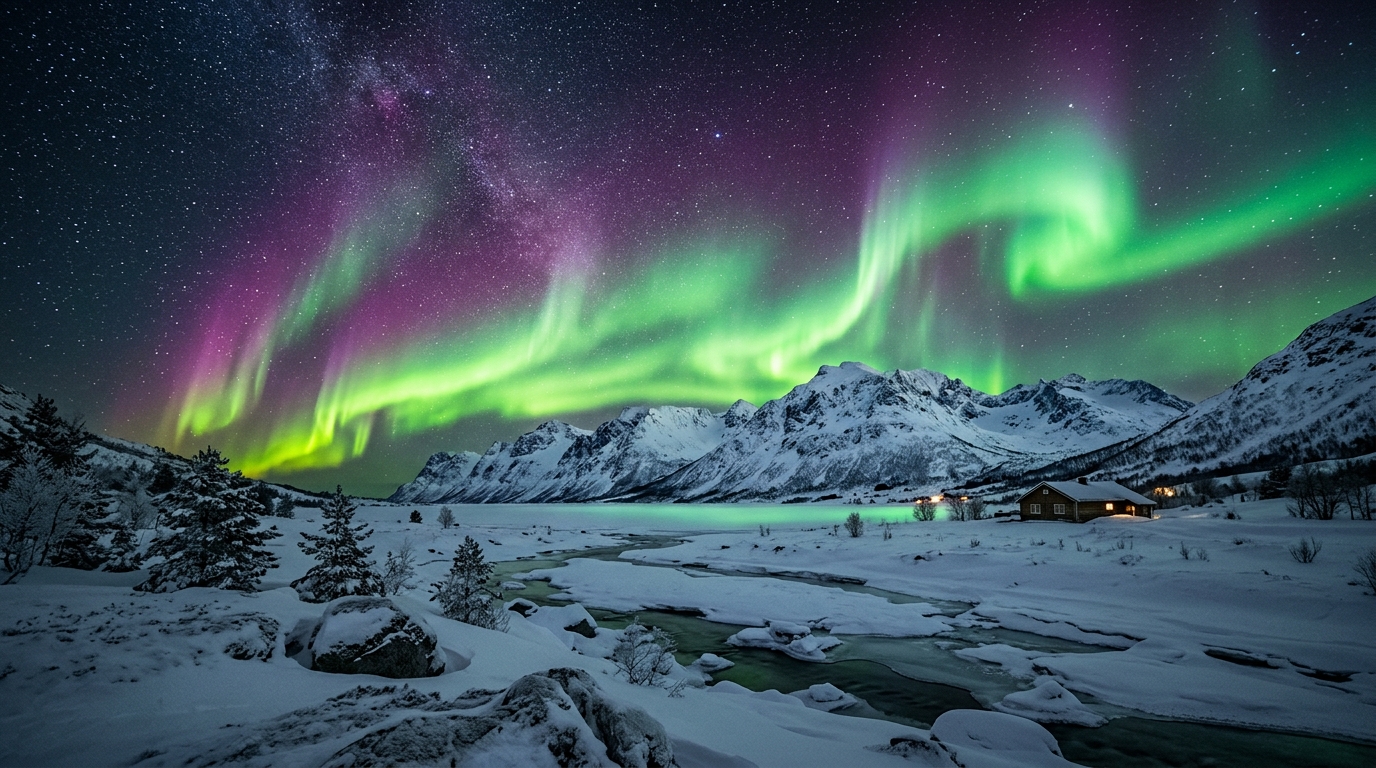
The northern lights, or aurora, are one of nature's most beautiful displays: waves of green, pink and purple light shimmering across the night sky. Traditionally, they are seen only in far northern regions close to the pole, such as Norway, Iceland and northern Canada. Recently, however, people much farther south have been surprised to see them too.
The explanation begins at the Sun. Our star constantly releases streams of tiny charged particles into space. When these particles reach the Earth, they are guided towards the poles by the planet's magnetic field, where they collide with gases high in the atmosphere. These collisions make the gases glow, producing the coloured curtains of light we call the aurora.
The Sun, however, is not always equally active. Its activity rises and falls in a cycle that lasts roughly eleven years. At the calm point of the cycle there are few auroras; near the peak, the Sun becomes stormy and throws out far more particles. We are currently close to one of these peaks, so auroras have grown brighter and stronger, and the glowing lights have pushed much farther from the poles than usual. As a result, many people are enjoying their first-ever sight of the northern lights.
For those who manage to catch them, the experience is unforgettable. The lights can appear as a faint glow or as bright, moving ribbons that change shape from one minute to the next, and no two displays are ever exactly the same.